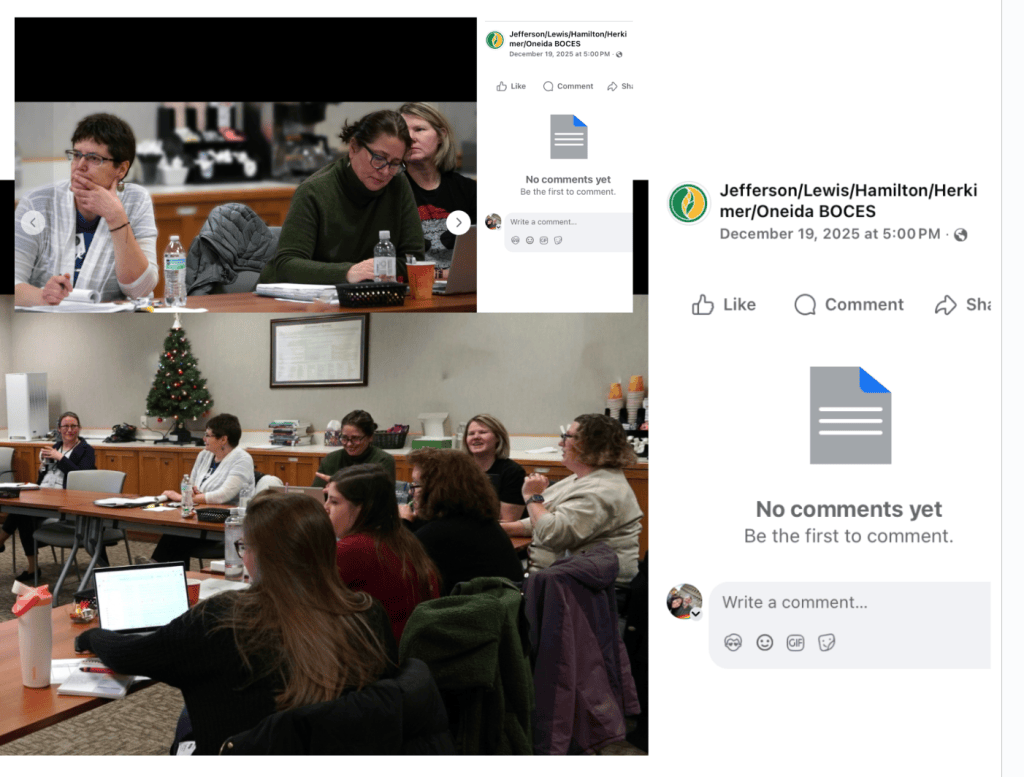
I’ve been digitally carrying this screenshot mashup for a while now. I keep coming back to this picture pairing because it so clearly shows what I know about my profession: librarianship holds joy and gravity in the same hand.
In the first image, our small group is gathered around a conference table, and every face is doing the same thing: leaning in, brows knit. You can feel the weight in the room. We were talking about library policies and about librarians across the United States who had been fired for holding fast to their professional norms — working out how to respond should we find ourselves having to defend our students’ right to learn. In the second photo, taken that same day, the room looks like a completely different place. We are laughing, mid-story. There are relaxed faces and smiles, and a laptop open to notes nobody’s looking at anymore, because we’re too busy enjoying shared stories of student success and connection.
That joyful part is the part most people picture when they think of librarians, and it is real. It’s the read-aloud that gets a whole room of squirrelly second graders leaning forward for the next part. That “hang time” is my favorite part of story time! It’s the student who comes back for the sequel before you’ve even finished shelving the first book. It’s watching a reluctant reader turn into someone who argues with you about which series is better. It’s the student barelling into the library at the start of the school day, holding a book aloft and saying, “you aren’t going to *believe* what I learned about Axolotl’s in here!” That joy is the job.
What’s less visible — until a picture like this one puts it side by side with the joy — is the quieter and heavier work of protecting the conditions that make that joy possible in the first place.
Challenges to books and to the work librarians do aren’t new, but the ever-growing volume and coordination behind those challenges has changed the day-to-day reality of this profession in a real way. When a title is challenged, for example, it isn’t a five-minute conversation. It’s policy review. It means rereading the book, cover to cover, often for the second or third time, specifically so you can speak to it with precision instead of instinct. It means reviewing those professional reviews you or your predecesor relied on when you added the book to your library in the first place. It requires checking your collection development policy, your latest state guidance, your board policies and approved procedures. If you are lucky and your school procedure spells it out, it means sitting in a room with colleagues, working through the specific passage someone has objected to, and asking the questions that actually matter: Who is this book for? What does removing it teach the kids who do see themselves in it? What does keeping it teach the ones who don’t?
That’s the room in the first photo. This is not an adversarial room, and it’s not a room full of people spoiling for a fight. It’s a caring room full of people taking a responsibility seriously — the responsibility of making sure that a young reader, whoever they are and whatever their family looks like, can walk into a library and find a book that tells them they exist and they’re not alone.
I think we do our profession a disservice if we only ever show one half of this. If we only show the joyful half, people assume the challenges to intellectual freedom are overblown, rare, and someone else’s problem. If we only show the serious half, we risk framing librarians as perpetually embattled, and we lose the why — the kids, the curiosity, the reading and learning and creating that make the serious work worth it.
Both photos are the job. The seriousness is in service of the joy. We sit with the hard, procedural, sometimes exhausting, work of defending the freedom to read precisely so that the next kid who walks in can have that unguarded, laughing, “you have to read this” moment with a book that might be exactly what they needed.
Here’s what I hope you will take from a photo like this one: the people doing this work are choosing diligence. When you see a librarian pushing back on a challenge, or citing policy, or asking for a fair process before a book comes off the shelf, they are not seeking to obstruct — they are practicing the same care and attention that goes into creating joyful moments and welcoming spaces; curating meaningful collections; and connecting with library users.
The next time you see librarians smiling in a photo, know that somewhere nearby — maybe even that same day — there’s likely another photo you didn’t see, of the same people doing the less photogenic work that makes the smiling one possible.



Leave a Reply