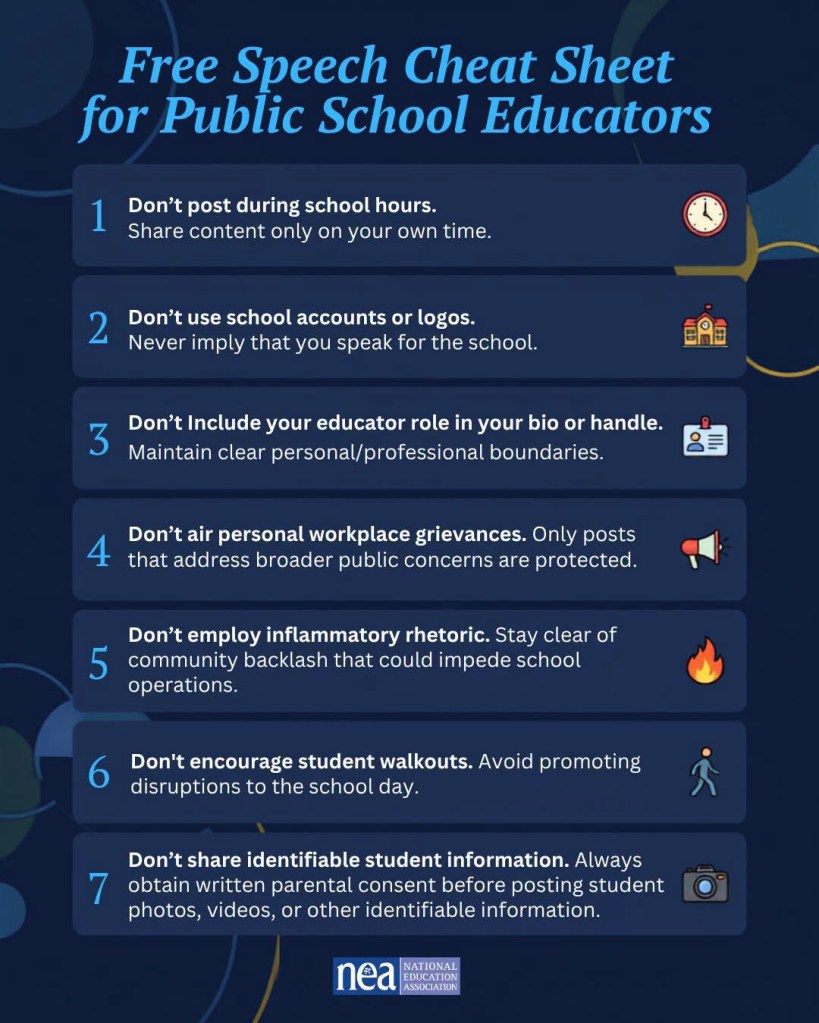
If you work in education, you’ve no doubt seen the National Education Association’s Free Speech Cheat Sheet for Public School Educators. This list outlines professional conduct that will keep you on the right side of the law, as well as in line with almost any district policy. You can find a deeper dive into educators’ responsibilities and rights in the July 2026 article Are Educators’ Social Media Posts Protected by Free Speech by Nicole Cennamo from the NEA’s Office of the General Counsel.
One item on this list, which I’ll refer to here as “Rule 3,” gave me pause and has me thinking deeply about who I am and how I conduct myself online and in person. I wonder how my fellow educators feel about it. I can’t be alone in questioning this advice: Don’t include your educator role in your bio or handle. I am certain it is prudent legal advice. I understand the idea behind it. The more I think about it, though, the more I question whether this is the best way to support our students, our colleagues, and our communities. I suspect that in the regular flurry of back-to-school activity and training, a lot of us absorb this sort of advice without examining what it actually prompts us to do.
Looking closely at the NEA’s cheat sheet, six out of the seven items cover conduct, outlining pitfalls to avoid that include when you post, what platforms you use, whether you are claiming to speak on behalf of your institution, whether you are causing a disruption to learning, and how you maintain student and school privacy. The focus of this advice, beyond keeping yourself out of legal trouble, is building and maintaining professional trust. There is no question that trust is a, perhaps the, vital component of our profession. Advising educators to not include their educator role in online bios, though, asks us not to be knowable as educators. That is a big ask. It may be easy to conflate “don’t speak for your school” with “don’t let people know you are a teacher.” They are not the same. The first protects the institution from being misrepresented. The second asks us to obscure a core piece of our professional identity. “Educator” is not a costume I put on in the morning and then shed at the end of a school day. It is who I am. My colleagues know what I do. Parents around town know. Students and former students know. My neighbors know. Hiding the word “librarian” from my bio won’t erase those associations, it just strips away the context, the authority, and the accountability that comes with being visibly, openly, a connected online professional in my field.
Education is one of the most publicly litigated topics in American life. Curriculum, book access, funding, pedagogy, the role of AI in classrooms — these conversations are happening around us. When we suggest educators strip their professional identity from their bios on public platforms, we seem to be asking the people best positioned to bring lived expertise to these debates to opt out. Not because they lack informed opinions, but because they have been told, repeatedly, that their professional credentials are a liability and not a qualification that brings value to the conversation. Compare this to how we treat other professions. We don’t ask physicians or scientists to remove “MD” or “PhD” from their bios so no one mistakes their personal opinion on public health or climate trends for institutional policy. We trust the public, and trust the professional, to understand the difference. Education deserves the same standard.
I am not making a case that educators say whatever they want, however they want, under the banner of their job title. I am totally on board with the guidance from the cheat sheet that draws concrete, necessary lines emphasizing our responsibility to conduct ourselves in ways that protect our students, schools, and colleagues. These responsibilities aren’t in tension with what I’m questioning. They’re on a different axis entirely. There is a real and important difference between identity disclosure, institutional affiliation, and conduct.
I recognize the fear that likely drives Rule 3. Educators are, right now, in an unusually exposed position. We are subject to social media scrutiny, political hypersensitivity, and real professional risk simply for being identifiable while holding an opinion. That fear is not irrational or baseless, and any honest consideration of the cheat sheet has to sit with that.
I believe the answer lies not in hiding who we are. I believe we should encourage and engage in conversations in which we are calm and clear that our experience gives us unique insight. We should strive for greater visibility and transparency. A strong and simple disclaimer — views are my own — does the actual work that hiding one’s profession only pretends to do. Combined with the professional conduct outlined in the Free Speech Cheat Sheet, a disclaimer draws the line Rule 3 is actually trying to draw, without asking educators to disappear as professionals in order to stay safe as private citizens.
If I were rewriting Rule 3, it would be something like this: Be identifiable as an educator. Be unmistakable that you do not speak for your institution.
That rewrite protects the boundary between personal opinion and institutional position without asking educators to deny their profession. It also gives administrators and districts the liability protection they are understandably looking for. We ask a lot of educators. We shouldn’t be asking them to be quiet about the expertise and experience that makes their voice vital to the conversation.
Dog-Eared & Overdue is written by a middle school librarian in northern New York who supports all her colleagues as they speak up for what is right, share kindness whenever they can, celebrate each other and themselves, and always narrate their own stories. All views are her own. This information is not presented as legal advise.



Leave a comment