Fritz and Theresa
Content Warning: Before you dive into this piece of my family’s history, I want to gently share that this story touches on themes of addiction. If this topic is difficult or triggering for you, please feel free to sit this one out or come back to it another day. Take care of yourself.
The Orphan in My Family Tree is the true tale of my ongoing search for information about the origins of my great great grandpa Fritz, who was orphaned in New York City in the late 1870s and sent as a young boy to live with a foster family in Bow Valley, Nebraska. This installment explores what I have found about Fritz’s life as an adult.
On February 9, 1904, 29-year-old Fritz Brand married 26-year-old Theresa Wiebelhaus. Their marriage license lists him as born in New York, New York, and her as born locally in Cedar County: two very different starting points for these newlyweds. For a man who had crossed half a continent alone as a child and spent his adolescence being counted on other families’ census rolls, this marriage must have marked something enormous — the start of a family that would finally, fully, be his own.
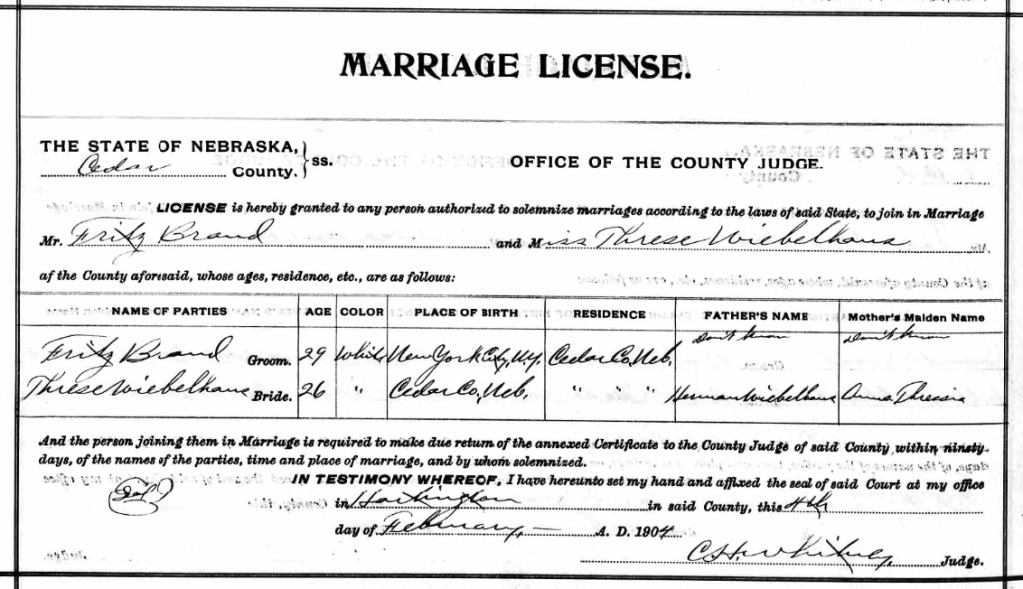
Fritz and Theresa met at the Catholic church that played a central role in Bow Valley town life, and the wedding announcement that appeared in the local newspaper was hopeful:
Fritz Brand and Miss Theresa Wiebelhaus were married Tuesday at the Bow Valley church, Father Birnbach officiating. These young people are well known and have the best wishes of a host of friends. Mr. Brand is an energetic young man and a successful farmer and the bride is one of Bow Valley’s charming and prominent young ladies.
The Hartington Herald, February 12, 1904
Their children arrived steadily over the next several years, each birth a milestone in the life Fritz and Theresa were building. Lawrence arrived in October 1905. Susan (my Great Grandma Sue) was born in December 1906. Local infant mortality records reveal the couple lost a child in infancy in 1908. The child was a daughter according to the record index, a son according to family tradition. Federal Census records from 1910 list Theresa as mother of four children, three of them living, which corroborates the loss of a child but does not help resolve whether that child was a daughter or son. Hilaria joined the family in August 1910, and Raymond in April 1911. The Brand family settled into farming life. As a young man, Fritz worked for Frank Arens, the brother of his foster father. Around 1911, Fritz and Theresa leased land six miles north of Hartington. Newspaper reports announce the family experienced a partial barn fire in March 1911, and then, soon after, reported Fritz’s plans to put up new buildings on the land. By December of that same year, Fritz was talking about the possibility of moving to Texas to invest in land (a plan that, as far as the record shows, never came to anything). Finally, in March 1912, the family moved into a house on Broadway in Hartington.
Every family history has chapters that are harder to write, and Fritz and Theresa’s life during this period holds some of those. In 1909, a Public Notice printed in the November 4th edition of the Cedar County News advises “All saloon keepers, druggists and all other persons are hereby warned not to sell or give any intoxicating liquors of any kind to Fred Brand, as he is a habitual drunkard.” This prohibition was lifted in the same newspaper on August 18, 1910, under the headline “May Sell Brand Booze.” Later in 1910, local papers report the more mundane news that Fritz was a visitor in Bow Valley in early December and that he had lost a horse later that month.
In mid-July 1912, Fritz Brand, described in the Cedar County News as “a local character” was placed under guardianship and charged with drunkenness, followed by a peace bond ordered by the local judge. According to the newspaper, Fritz had come home intoxicated and “raising a disturbance which necessitated interference of his neighbors.” Similar arrests appear again in 1913 and 1916 — glimpses, scattered through the newspaper archive, of a real struggle with alcohol and of instances of abuse. In July of 1913, Fritz spent four days in jail after being charged with intoxication. The judge suspended what should have been a longer sentence due to good behavior. By September of 1913, Fritz was working again in Hartington. In the fall of 1914, Fritz was doing carpenter work northwest of Fordyce, Nebraska, according to The Fordyce Press. In mid-February 1916, The Hartington Herald reported that Fritz was once again in jail, this time for drunkenness and resisting an officer. He was kept in jail, through the weekend, with the understanding he would be released on Monday, “when he was to receive a good, square meal and go to work for Henry Lange.” It seems that Fritz was able to continue his employment with Mr. H. G. (Henry) Lange throughout 1917 and at least into the beginning of 1918. After this time, Fritz, or “Fred” as he was more often referred to in the local newspapers by this time, appeared as a laborer for local man, William Beckenhauer, and then throughout the following years in town board minutes as receiving income for general labor and snow shoveling.
Circling back to July 1916 with an eye on searching for what Fritz’s wife and children were experiencing, local notes in the Cedar County News and Hartington Herald reveal Mrs. Brand (Theresa) and children spending Sundays with friends or relatives in nearby towns of Bow Valley, Crofton, and Fordyce. In 1917, daughters “Susie” and Hilaria received their First Holy Communion alongside thirty-one other children at Holy Trinity church in Hartington. When my Great Grandma Sue eventually described her girlhood to my mother, Grandma Sue talked about how hard her father’s drinking made things; how difficult it was for him to keep a job; and how her mother took in laundry for the local priests to make ends meet.
Even having known this, it has been difficult to read contemporary newspaper accounts of Fritz’s addiction and imagine how it affected his family.
It is human nature to want to smooth these details out of a family story, but they belong here as much as anything else. The newspaper reports of Fritz’s drunkenness are as true as the accounts of his ordinary, hardworking days — plastering the new schoolhouse with Henry Koenig in 1913, working steadily as a laborer, raising 150 chickens that were then lost to a sudden flood, delivering ice for the Hartington Ice Company in the summer of 1918. This was the reality of Fritz and Theresa’s family life.
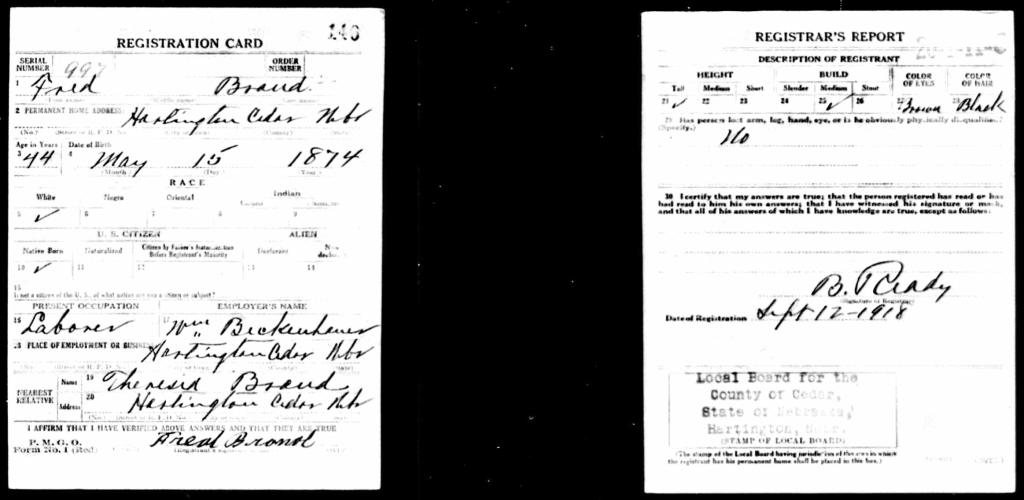
In September 1918, at 44 years old, Fritz registered for the WWI draft. His card is a small treasure of physical description: tall, medium build, brown eyes, black hair, working as a laborer for a man named Wm. Beckenhauer. It’s easy to imagine him signing that card in the fall of 1918, with the war’s end just weeks away — one more historical current he happened to be standing in. It’s easier still, with this physical description in hand, to picture that young boy in New York who was sent to the Protectory, and then sent west to a different life with a family of strangers. I want to show grace to that boy I have grown to care about through my years of research. And I also want to protect Theresa and her children when I consider how his own unresolved trauma, his choices, and his behavior undoubtedly caused them real hardship.
Between 1919 and 1922, news about Fritz becomes more scarce, whether because things had quieted down for the Brand family or simply because a man scraping by on day labor wages made for less newsworthy copy that a man in jail. In February 1920, the family moved to a neighboring farm, renting out their home in town. In August 1921 the newspaper reports a case Fritz brought toward a local employer for “wages claimed” was dismissed. This hints at a family still living close to the edge financially. In March 1922, The Hartington Herald shared news of the Brand family having city water hooked up to their residence and a bathroom installed, a potential marker of stability after years of hard luck. It seems stability and grief were never far apart for Fritz and Theresa, though. Mrs. Weibelhaus, Theresa’s mother, passed away in April. Soon after that, Raymond, Susie, and Hilaria were confirmed along with other local children in Hartington.
It is tempting to end here, on this note of uneasy equilibrium. The record doesn’t offer straightforward endings, though, and we have just a little farther to go in our journey.





Leave a Reply