The Orphan in My Family Tree is the true tale of my ongoing search for information about the origins of my great great grandpa Fritz, who was orphaned in New York City in the late 1870s and sent as a young boy to live with a foster family in Bow Valley, Nebraska.
Fritz Arrives in Bow Valley
![A close-up photograph of a handwritten letter in dark ink on light-colored paper. The elegant, cursive handwriting features long, sweeping loops and slanted lettering characteristic of older historical correspondence.The visible portion of the letter reads: George is well and he wants to stay here and wants me to write you John Devine the teachers father has a boy much smaller than George and they say he is seventeen he hasent [sic] been a day to school this winter now I will look to you to help us out this time let me hear from you by return mail that George can pass for sixteen the third of May the latest..."](https://kategukeisen.com/wp-content/uploads/2026/09/img_4765.jpeg?w=1024)
It is both hopeful and heartbreaking to picture: a train car full of children, none older than eight, rattling westward across a landscape none of them had ever seen. In May 1881, newspapers described fifty orphan boys leaving New York to head west. Days later, “thirteen bright lads ranging from 4 to 8 years of age” arrived in Sioux City, Iowa on their way to their final destination of Bow Valley, Nebraska. What at the time was routine local news must have been the most extraordinary and disorienting of experiences for the boys involved.
Among those thirteen bright lads was seven-year-old Fritz Brandt, sent west through the New York Catholic Protectory’s placing out program. The Orphan Train movement — a movement most often associated with Rev. Charles Loring Brace and the Children’s Aid Society of New York — was in full swing relocating homeless, orphaned, and disadvantaged children from Eastern cities to new homes across the Midwest. First-hand accounts from Orphan Train riders have shed light on what the experience was like for these children who were asked to trade one world for another in the space of a few days on a train. Many of these accounts mention the children being told they must forget their old lives and never mention them. We can’t know what care or advice Fritz received on his journey.
When Fritz arrived in Bow Valley, Cedar County, Nebraska, he would have seen rolling farm country about as far removed from the streets of New York as a boy could imagine. There, he was taken in by the William Arens family, one of the German Catholic families that was foundational in settling the area. The Arens family and their neighbors were probably still recovering from the disastrous flooding of the Missouri River that spring and from years of crop damage due to grasshoppers, prairie fires, and grueling winters when they welcomed the orphaned, half-orphaned, or destitute boys into their homes.
We don’t know anything about the first meeting between Fritz and the Arens family, but we can imagine our travel-worn boy, the family who had been waiting to take him in, and the enormity of the beginning of an entirely new life.
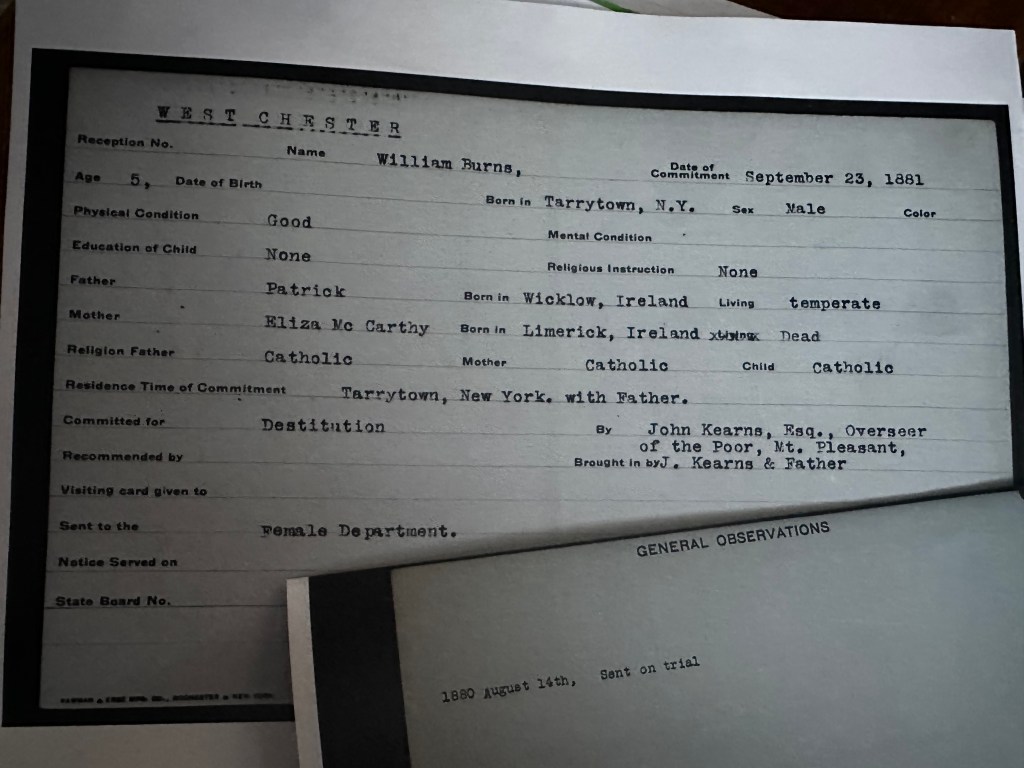
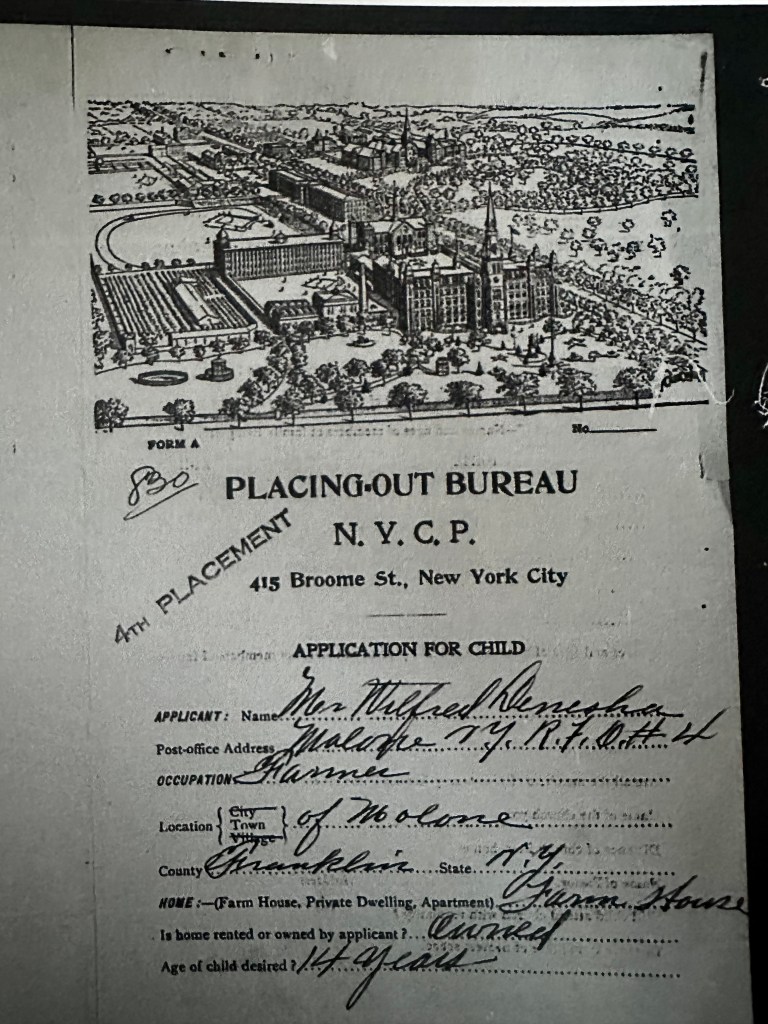
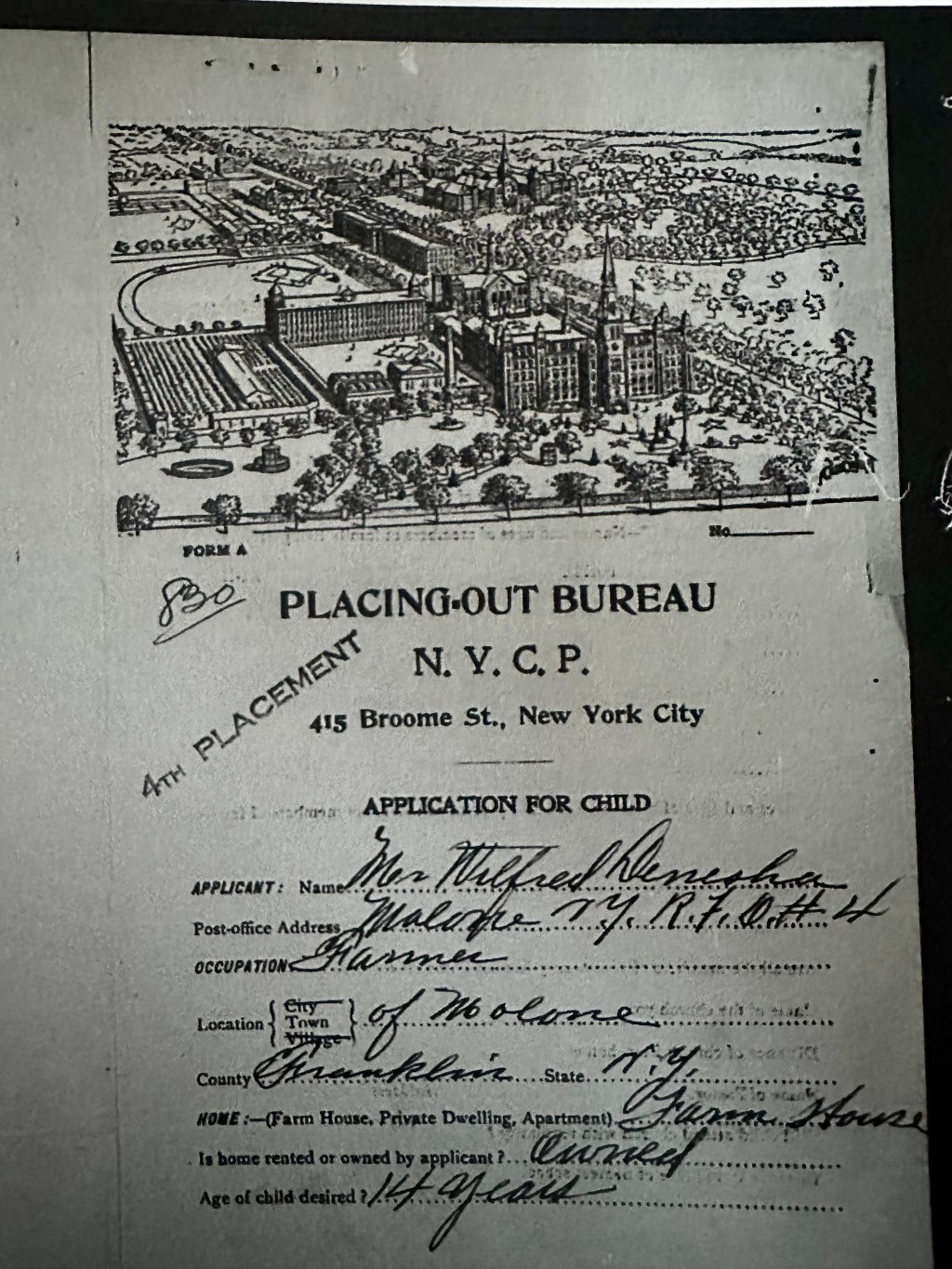
What follows in the record is overwhelmingly ordinary, and important to helping me narrow down the beginning of life in Nebraska for our young Fritz, whose given name was reported to be Fred or Frederick. The 1882 school census lists him plainly: “Fred (7),” listed alongside two children from the Arens family, Joseph and Odelie. “Fred (8)” turns up similarly in 1883. By 1884, the census records him as Arens household member “Fritz Brandt (11)” — a curious jump in age from the year before that has puzzled family researchers, and the reason his birth year has always been remembered as somewhere between 1872 and 1874. A birth date is a small detail, but one that most of us today know with such certainty it feels unmooring to not have found. Moved between caretakers and institutions, Fritz and the family with whom he resided seem to have been unsure of his age. There is evidence that in some placing out situations (see photos), families appealed to the protectory staff to adjust a child’s recorded birthdate to a more convenient one that would enable orphans to present as old enough to not be required to go to school anymore, which freed them up to help with farmwork and housework full time. It is impossible to know whether this was the case with Fritz. Contemporary accounts of Fritz describe an unusually large and strong man, which has always made me wonder whether the Arens family didn’t just, in the absense of records to the contrary, adjust Fritz’s birthdate to one that seemed more reasonable given his size.
By 1885, an official Nebraska state census recorded a 12-year-old “Fred Brandt (W, M, Orphan)” living with the “William Ahrens” family. The word orphan entered plainly in the “Relationship to Head of Household” census column was useful from a research standpoint, but inspires in me so very many questions. In the same census, our handful of “Bow Valley boys” are each categorized as an “orphan” in the census record. While I understand that “taking in” a child is quite different than adoption, and that during this time it was generally an arrangement in which housing and schooling was exchanged for farmwork or domestic labor, I am curious about the relationship between Fritz and the Arens. While other boys, in future census records, are recorded as “adopted” or simply as “son” in the relation to head of household column, Fritz seems to have remained somewhat separate from the Arens family. His name appears once more in the 1886 school census, still with the family, still just “Fritz Brandt” — a name that would be spelled different ways across his lifetime, depending on who was doing the writing.
When I imagine Fritz’s childhood in Nebraska, I picture German hymns and harvest suppers, one-room schoolhouses, and the quiet of the plains. That quiet must have felt foreign to Fritz after the noise of a city he may have already been forgetting, or may have been pining for. I wonder if the quiet brought comfort or desolation. I wonder if he missed the city in spite of his hard circumstances there. I wonder if he remembered his parents. I wonder if he felt cared for. I think about the history he lived through, and then I think that for him it wasn’t living through history, it was just living.
On January 12, 1888, just weeks after his sixteenth birthday, the Schoolhouse Blizzard struck the region. It remains one of the deadliest storms in Great Plains history, a freak weather event that dropped temperatures with almost no warning and caught thousands of people, including schoolchildren walking home, out in the open. It is unlikely Fritz was in a schoolhouse that day. He was probably out on the Arens farm or working for a neighboring farmer. He lived through a storm that killed an estimated 235 people across the region.
By the mid-1890s, Fritz, who was now in his early twenties, starts appearing in local newspapers under his own name. No longer folded into the Arens household, Fritz appears as a young man with his own small dramas in community announcements and news. In August 1895, the local paper reported that “Fritz Brandt fell and was kicked by a horse” near Bow Valley — a jolting reminder of just how physically dangerous everyday farm work could be. By December 1898, the local social pages mention he’d gone out “husking corn,” one little update that places him squarely in the rhythm of agricultural life that defined much of his early adulthood.
The 1900 census captures Fritz at 28, still single, working as a “servant” in the household of local farmer Stephen Stevens. At an age when many of his peers might have already been established on their own land, Fritz was still working for wages in someone else’s home. Soon, Fritz would establish a household of his own.
Suggested links for further reading
Chronicling America | Nebraska Newspapers at the Library of Congress
Nebraska Newspapers | UNL Digital Newspaper Program
Nebraska Memories | Cedar County in this era.
Looking Back on the Blizzard of 1888 | History Nebraska’s own account of the Schoolhouse Blizzard.
New York Foundling Hospital Records




Leave a Reply