This is Part 9 of The Orphan in My Family Tree. It is the true tale of my ongoing search for information about the origins of my great great grandpa Fritz, who was orphaned in New York City in the late 1870s and sent as a young boy to live with a foster family in Bow Valley, Nebraska.
The Story
It has been a minute since I’ve written about Fritz. What started as “I’ll get back to this soon” turned into “um, it’s been years.”
Life has a way of meandering. Research does too. In addition to thinking about Fritz, I’ve been thinking about the curious, patient souls who have followed along on this journey — it is clearly time to stop thinking and start writing. If you’ve read every installment of this series, consider this a refresher with a warm cup of something cozy. If you’re brand new here and stumbled in wondering what on earth I’m talking about, pull up a chair.

Fritz — whose given name was probably actually Frederick — is my great-great-grandfather on my mother’s mother’s mother’s side. He is, in genealogical terms, an irresistible mystery. So many other roots in my family tree are readily traced to immigrants who crossed oceans: homesteaders from Germany who built lives on the Nebraska prairie out of sod and stubbornness; fishermen from the Wadden Sea who bet on a broad horizon against the red tide algae blooms that threatened their livelihood; pragmatic pilgrims from England who came to their “new world” (after a few years in the Netherlands) seeking religious freedom and economic opportunity. All of these roots grounded to readily findable places and routes on a map as well as to commonly understood reasons for seeking brighter futures in a new homeland.
Fritz, though, has always seemed to spring forth from nothing. There is no tangle of roots behind him in the tree to give himself stability or to weigh him down. There is only family lore, curiosity, and a young boy who arrived alone to the prairie on which I grew up, albeit about a hundred years before I came on the scene.
The few scraps of information I had about Fritz while growing up were that he was a “character” and that he was a big man who had the strength of an ox. As a kid who loved to listen to stories, it seemed that everyone who knew local history knew that Fritz was famous for lifting three bags of oats (about 80 pounds each) at a go in exchange for a cold beer on a hot day.
According to family stories, Fritz was born somewhere in the early 1870s in New York City. His parents, the story goes, grew sick and died in one of the epidemics that regularly swept through the tenements on the Lower East Side of Manhattan. Fritz’s parents may have been German or may have been French. His father, possibly also named Fred or Frederick, may have been a cobbler. Stories and speculation convey that he may have stayed briefly with a grandmother after his parents died. He may have had a sister. How many of these stories were true and how many of them were the embroidery of the generations between Fritz and me is what I’m curious about.
The Research
I came to Fritz’s story the way most of us come to family history. I started with the stories I knew and worked toward everything I didn’t know. My mother, a genealogist who has long been the finder, keeper, and sharer of family stories, gave me everything she had on Fritz and wished me luck. (She was deep in a branch of the family where everyone had twelve children who each had fourteen children, and I was quite satisfied with one person to track down.)
Fritz arrived in Bow Valley, Nebraska — one of many children placed with families on the frontier through what we now think of as the “orphan train” movement of that era. The family who took him in, the Arens family, were instrumental in settling Bow Valley and establishing the Catholic community there. Fritz put down roots in the Nebraska prairie that would grow into a whole new branch of our family tree. We took as gospel the oft-repeated family story that the orphanage he came from burned down shortly after he left — taking his records with it and leaving him history-less.
The early posts in this series were about laying groundwork and learning what resources exist for this kind of research. Those posts were also leading toward a better understanding of the world Fritz came from, as well as confirming the basic details of his story.
Census records are always a solid starting place when researching ancestors. When Fritz didn’t appear in the 1880 Federal Census for Nebraska, that helped narrow the focus of the search. In the 1885 Nebraska Census, he appeared: Fred Brand, Orphan, aged 12, listed in the home of William and Maggie Arens in Township 5, Cedar County — also known as Bow Valley. He was exactly where the family story said he would be.
School census records narrowed things down further. A seven-year-old Fred appears in the Bow Valley school census in 1882, and his name shifts to “Fritz” in the records by 1884. The records, taken together, suggest Fritz arrived in Nebraska sometime between the summer of 1880 and the spring of 1882, most likely around age seven, just as the family story claimed. Two important clues confirmed.
From there, the research expanded into what Fritz’s adult life in Nebraska looked like (marriage records, birth certificates, county and church records), and into the world of his early life in 1880s New York City. The staggering number of children who were orphaned or displaced during that era is heartbreaking, and the approaches of the different organizations and people who participated in the placing out of children like Fritz is fascinating.
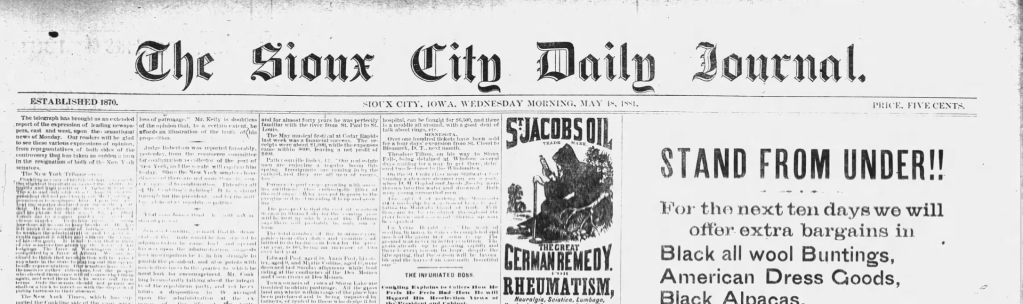
Morning Edition, Wednesday, May 18, 1881
The New York Catholic Protectory
An 1881 newspaper article from the Sioux City Journal, discovered through Newspapers.com, turned out to be a pivotal clue for pinning down Fritz’s arrival to Nebraska. The article, titled “Juvenile Immigrants,” described a number of “bright lads” being sent from a New York Catholic institution to settle with German farm families in northeastern Nebraska, supervised by a man named Captain P.C. Dooley. Captain Dooley, it turns out, was the Supervisor of Admissions and Discharges at the New York Catholic Protectory, and he had traveled to Nebraska to place children with the Arens and other neighboring Catholic families.
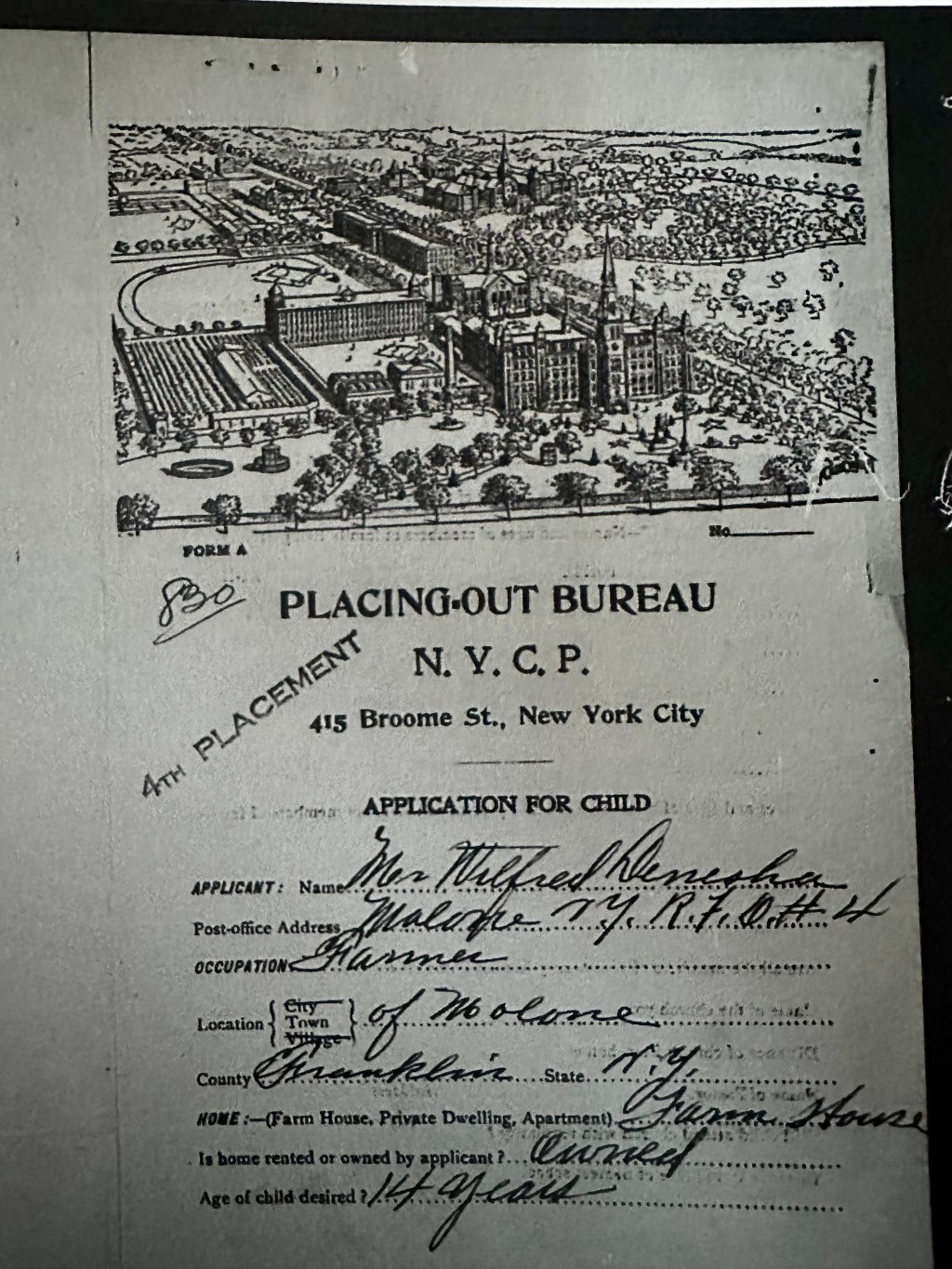
The New York Catholic Protectory was a large institution on the outskirts of New York City that was home to thousands of children — many of them children of immigrants who had been orphaned, abandoned, or whose families simply couldn’t afford to care for them during a time of devastating poverty and disease. Their annual reports, their records, and the stories that emerge from both paint a vivid and heartbreaking picture of the world Fritz came from.
In a variety of records, I found other children who appear to have come to Bow Valley through the same pipeline, those “bright lads” mentioned in the newspaper article. I found them in school census records alongside Fritz, and in Captain Dooley’s admissions reports. I also found Father Frederich Uhing, the first resident pastor at Saints Peter and Paul Church in Bow Valley and an immigrant from Germany (like the Arens), who appears to have played a significant role in coordinating the placement of these children with local families.
Meet the Parents (Maybe)
I widened my net and dove into New York City records from around 1880, certain that Fritz was not in Nebraska yet and hopeful that meant he could be found somewhere in New York. Hoping beyond hope that perhaps his parents were in those records to be found, too. Mortality schedules, census records, city directories — you name it, I searched it. After a great many false starts and investigations for people who turned out not to be “ours,” two names kept resurfacing: Elizabeth Brandt and Frederick Brand. Both had died in New York City in 1880, both had roots in Germany, and both seeming to appear out of nowhere. Neither had an obvious connection to Fritz, but I was compelled to keep digging.
I sent away for Elizabeth’s death certificate. When it came, I found so much information and had so many more questions. Elizabeth had died of uterine cancer in January 1880, just 35 years old, after a month of treatment at Charity Hospital on Blackwell Island. She’d lived in Kleindeutschland, New York’s vibrant German neighborhood. Promising, but not conclusive.
Then I sent for Frederick’s certificate. The day I received it my heart did a little jump. He had the same address as Elizabeth. He’d died just a few months after she had — a 38-year-old widower, a German laborer, buried in a potter’s field. The pieces felt like they were trying to fit together.
I confirmed they both lived at 1120 First Avenue, at least for a few years, using New York City directories. I could link them to each other — but could I link either of them to Fritz? That’s the question that keeps me going.
A few years on, I’ve made some progress and learned so much more about the time and place Fritz experienced — but Fritz’s story remains full of questions.
Why This Story Matters (To Me, and Maybe to You)
What I’m really looking for, underneath all the census records, city directories, and church archives is the truth. Fritz’s truth.
The more I find, the more certain I am that answers to my questions are not going to be comfortable or tidy or exactly what I expected when I set out on my quest.
Curiosity is an act of respect — asking questions about where we come from, even when the answers are incomplete or complicated or sad, is a way of honoring the people who came before us. Fritz deserves to be known. His parents deserve to have their story told. And if the full truth turns out to be something different from the family story — that’s okay.
That’s where we are. Caught up. Oriented. Ready to keep going.



Leave a Reply